Monday, August 26, 2013

Crone's Cobblestone Cottage

My husband and I  recently returned from a journey to California to visit family, hoping to squeeze a little time to relax on our own.  I had been hoping to be able to visit the San Diego Botanic Gardens and the gardens at the Getty, but alas some of my mother-in-law's unforeseen medical issues neede attention, so I'll have to postpone those visits fro another trip.  (I'm not so sure my husband was as disappointed to miss the stops...)  In the meantime I settled for enjoying the many varieties of plants thriving in a much milder climate we encountered along our way.

My husband made a reservation for Crone's Cobblestone Cottage in the Mission HIlls neighborhood of San Diego, walking distance to restaurants, coffee shops and shopping and a short drive to Balboa Park, Old Towne, Point Loma and numerous other enticing attractions in San Diego, enticed by the website promising:

"CRONE'S COBBLESTONE COTTAGE is a quiet and comfortable bed and breakfast in San Diego, California. It is both a retreat from the world and an excellent home base for exploring San Diego. Surrounded by flowers, ferns, trees and the vintage neighborhood of Mission Hills (a San Diego treasure) this tastefully appointed hostelry offers gracious hospitality that is refreshing to body and spirit."


"If you should find yourself strolling through Mission Hills (or, if you have exited The Cottage by its front door and turned left at the bottom of the stairs), you'll likely notice the Ponder Post there. It stands out because it doesn't quite belong, or perhaps because it belongs a little bit too well. It doesn't look to be of municipal issue, and it isn't. It's a site specific art piece.
On the Post there is a Ponder...
If you come back another day, the quotes will likely have changed.
Something to lift your spirits or make you smile."


It was all we'd hoped for and more.  Joan is a warm and welcoming hostess who has added many charming touches to her home over the years.  While the lovingly restored Craftsman details were impressive, I was especially taken with all she was able to tuck into her limited gardening space.   While the Ponder Post seems to have been a welcome addition to the neighborhood, I suspect the Little Free Library Box recently added may become even more popular.

Little Free Library, Ltd. began in 2009 as a program of the non-profit, tax-exempt 
organization Wisconsin Partners for SustainAbility, which has incubated several 
nonprofits projects and organizations.  Incorporated in Wisconsin, Little Free Library 
has a board of directors and a clearly defined non-profit mission:


       -  To promote literacy and the love of reading by building free book exchanges worldwide.

           -  To build a sense of community as we share skills, creativity and wisdom across generations.

Joan's Little Free Library box was designed and built by her son to complement the architecture of her lovingly restored 1913 Craftsman bungalow.


Little Free Library boxes invites passerbys to "Take a book.  Leave a book."

To learn more about the Little Free Library program and locate a box in your nearby community:


A lovely swing to sit and enjoy one of the books from the Little Free Library box.   One of these days I'll get around to converting my great aunt's old sewing machine into an end table like this one.


A staghorn fern positioned on this tree has attached itself and grown into a tropical focal point in the garden.


The bust of a young boy in the dappled shade of the garden behind the water feature was given to the gardener by a local homeless man she has befriended in the neighborhood.  She is also the mother of 2 boys, now grown men, as I am.


A stone seat is postioned by a gurgling stream for quiet meditation.


If you're not looking carefully you might miss the fairy house in the tree trunk.


I  loved this little guy and was thrilled to find one for sale for a reasonable price at a garden center later during our trip.

The post to ponder on the day we were reluctantly leaving San Diego, August 18:


Saturday, August 10, 2013

Gravel garden at the Olbrich

Jeff Epping, director of horticulture at Olbrich Botanical Gardens in Madison, said the gardens  established a gravel garden along with a rain garden just west of the herb garden in 2010 as part of an effort in to include components of sustainability.  Gravel gardens were pioneered in Germany and developed in the U.S. by Roy Diblik of Northwind Perennial Farm in Burlington. The gardens, once established, will need very few resources: no weeding, no watering, and no fertilizing. Diblik helped build the Olbrich gravel garden, topping off existing soil with four to five inches of washed quartzite gravel which doesn't break down quickly like limestone does, preventing weed seed germination.

 Epping said it was key to choose drought-resistant plants, and space them closer.  "You want them to mass up and grow together to create a solid plant bed," said Epping of the process that will take about three years.  The only maintenance is to keep organic matter from building up in the garden. Plants Epping and Diblik chose for this garden include the grasses prairie dropseed and purple love grass, Tennessee coneflower, goldenrod and bee balm.'


We discovered that elusive monarch we
had sighted in the herb garden had preceded
us to the gravel garden displaying native plants.
The monarch was discovered resting on Culver's root.
Despite the abundance of nectar plants, we spotted only this
one lone monarch during our stroll through the gardens,
not very encouraging for those of us hoping to help prevent
continued declines in their numbers due to loss of preferred
habitat.


Adirondack chairs provide a welcoming spot to rest and
observe the activity of busy pollinators in the garden of
native plants.


This is a photo of the gravel garden when I visited the gardens on a Master Garener bus trip last summer. earlier in the seasonwith grasses playing a more prominent role.


Friday, August 9, 2013

NEWSHA visits the herb gardens at Olbrich Botanical Garden in Madison

Monday I joined some friends from the NE Wisconsin Herb Society of America on a trip to Madison to preview some possible sights to include on a tour we will host for a herb group that plans to visit from Scotland next year.

After touring the state capital, we headed to the Olbrich Botanical Gardens which were featured as one of Horticulture magazine' 10 most inspiring gardens in 2007:

'A place of inspiration and beauty, Olbrich Botanical Gardens graces the shores of Lake Monona in Madison, Wisconsin, and offers its guests a 16-acre showcase of the best and hardiest plants for Zones 4 and 5. The display gardens at Olbrich—from the formal, sun-drenched herb courtyard to the acres of fragrant hardy roses—show home gardeners that even under the harshest conditions, beautiful plants can be successfully grown and used in innovative designs. Whether strolling past the meadow garden, with its bright dots of color in the spring, or surveying the view from the new That pavilion, visitors are reminded of the vision Michael B. Olbrich set forth as he went about acquiring land for the future gardens: “This park above all others, with a warmth and strength of love—of love of all the working world—should hold out its arms, should invite them into itself, until its naturalness and beauty enter into their lives.”—Carleen Madigan Perkins'

The gardens are free to visitors, with an entry fee to visit the butterfly exhibit in the conservatory.


After a brief introduction to the gardens on the free tram ride (donations welcomed), we headed for the herb gardens first being a n herb group after-all. 

"Olbrich's Herb Garden is designed as a series of smaller gardens meant to delight the senses and illustrate the historic and contemporary importance of herbs. Trees and shrubs border the entire garden and capture the herbal fragrances given off by a myriad of herbal plants within the garden.  Specialty herb gardens include the courtyard, tea, knot, thyme and sage, medicinal, dye, kitchen, mint and touch and smell gardens."


Potted fig trees at entry to herb garden
Obelisk of vines
Obelisk supporting vining plants
Note the curly branches woven into the
structure 
A "sinister" garden bed is included in the herb gardens
"Sinister" garden plants
A fascinating book by Amy Stewart, Wicked Plants, explores many of the possible plants that could be used in creating such a "sinister garden".
"Culling legend and citing science, Stewart's fact-filled, AZ compendium of nature's worst offenders offers practical and tantalizing composite views of toxic, irritating, prickly, and all-around ill-mannered plants." ---Booklist


Plants for gold and yellow dyes
Plants for blue and purple dyes
Ceramic bee skep in the herb garden

An appealing rustic rain "barrel" with a simple
rustice rain chain
Sensitive plant is one of the more intriguing plants
featured in the "touch and smell" garden
A bed of mint with taller varities planted in round metal
containers to prevent rapid spread
Spheres are scattered among the plantings in the mint garden.
A close-up of a dragon fly resting on one of the spheres
in the bed of mint.
 A large raised sundial is a prominent focal point in the herb
gardens
A sundial sits at the center of a traditional herb bed design
with carefully manicured boxwood hedges defining the
edges of the beds.
We pass beneath an arbor loaded with grapes as we exit
the herb garden

A prior visit to Olbrich Botanical Gardens with the Outagamie Master Gardeners several years ago had allowed time to take a peak at the herb garden and some of the other gardens.

As some of my herbie friends pointed out, Russian sage is not
considered to be a "herb", but it does add color and structure
to this herb bed with it's talll lavender spikes.

The bent twig edging used in the herb gardens caught my eye-
it seems it would be an inexpensive & easy addition to make
to our garden if we harvest the branches early when they are
still very flexible.  The willow branches and young red twig
dogwood branches we prune each spring should provide a good
source of materials.
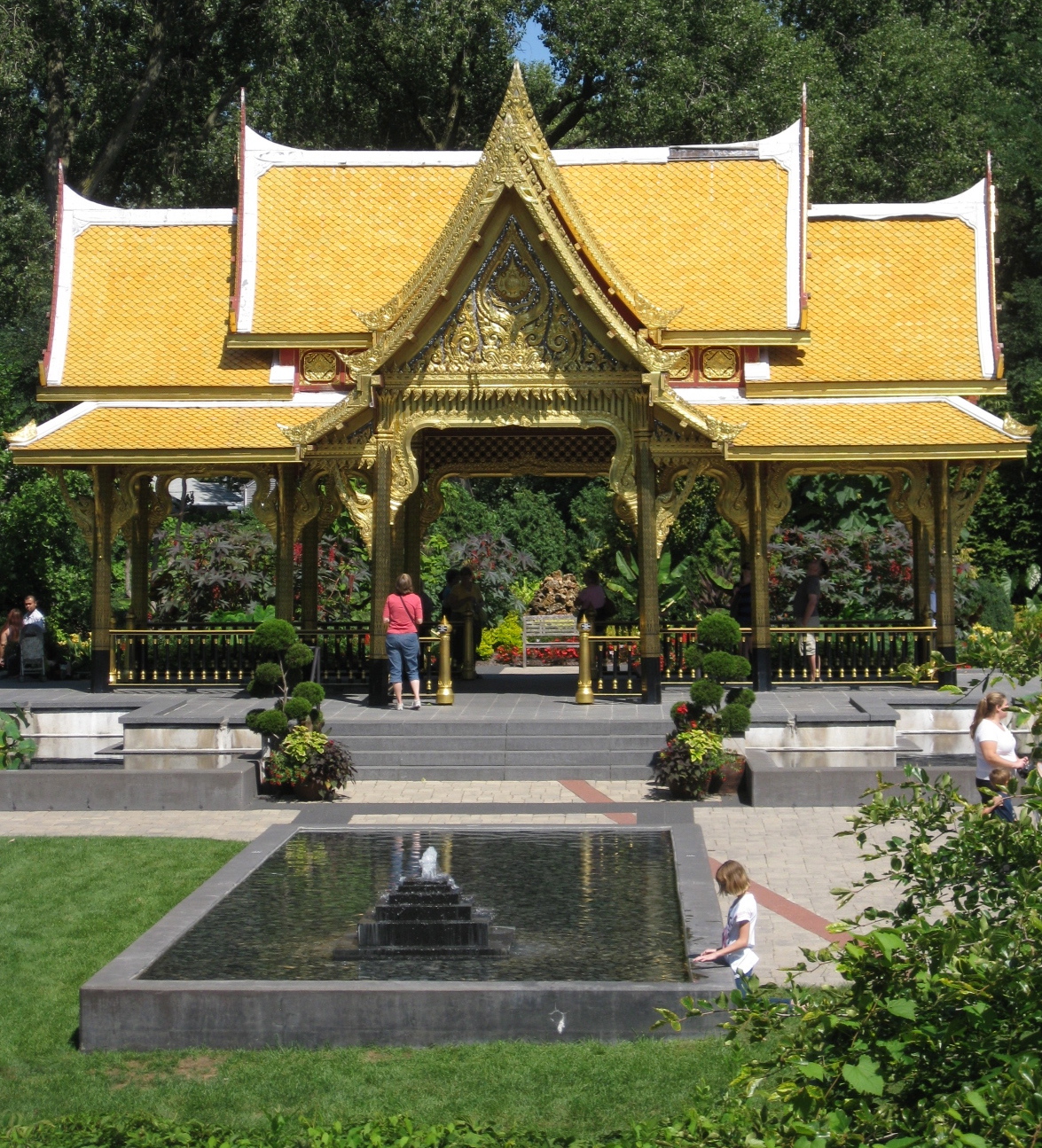
 One of the highlights of the Olbrich Gardens is the Thai Pavilion.  The pavilion was a gift to the University of Wisconsin-Madison from the Thai Government and the Thai Chapter of the Wisconsin Alumni Association. UW-Madison has one of the largest Thai student populations of any U.S. college or university.  The pavilion is able to withstand the winter weather of Wisconsin with no protection because it is constructed of plantation-grown teak and weather-resistant ceramic roof tiles. The gold leaf, however, is delicate and not able to withstand the oils of the human hand.  The Thai Garden surrounding the Pavilion emulates a lush, tropical garden with Wisconsin-hardy plants. Ornamental grasses, some reaching up to 12 feet tall, and several hardy bamboos are essential in creating a tropical look. Large-leafed shrubs and trees are pruned to give them the look of plants in a typical Thai garden. The Olbrich uses large Chinese junipers for clipped tree art called mai dat.


Monday, August 5, 2013

Hiking at High Cliff State Park in early August

As more native plants have been bursting into bloom, we decided to stroll to nearby High Cliff State Park to take a closer look this past weekend.


 Prairie Restoration


Butterfly Pond


Purple Martin houses near the entrance to High Cliff State Park


Purple Martin houses by the High Cliff Marina

Thursday, August 1, 2013

1st hummingbird of the season spotted

I spotted the first hummingbird of the season.  I had been starting to give up hope of having any visitors his year.   But my husband bought me the red feeders I had been talking about for my birthday.  I was hoping that bold red feeders with more prominent red color than just the feeding ports might stand a better chance of attracting the hummingbirds, despite my preference for colors other than red and orange in my garden.

Interestingly the hummingbird, butterflies and majority of pollinators seem to be attracted to a garden bed with coneflowers, globe thistle, swamp milkweed, and daylilies currently blooming.


The new feeder where I am expecting to see that hummingbird is surrounded by plantings purported to be hummingbird favorites:  bee balm (Monarda didyma),  anise hyssop (Agastache), columbine, phlox, lilies and butterfly bush.


I discovered an interesting link that allows people to document their 1st sightings of different species of birds each season.  There are charts available summarizing the months throughout the year individual species are most likely to be seen by counties within Wisconsin.

Wisconsin eBird