Saturday, October 26, 2013

Fall in Sherwood

A few photos on a drizzly day as more leaves begin to flutter to the ground.


Fall colors brighten neighborhood pond


Fall colors welcome last golfers of the season
at High Cliff Golf Course

Butterfly Pond Trail
Front yard in fall


Fall colors in back yard


Scanning the horizon from the back deck


The sun sets before 6 PM as the days shorten with the approach of winter


Tuesday, October 8, 2013

Hiking at High Cliff

Another hike last Sunday afternoon at High Cliff to enjoy the changing fall colors.

High Cliff Park Entrance

Butterfly Pond
HIgh Cliff General Store


Hiking up to the top of the cliff 

The Niagara Escarpment
High Cliff gets its name from the limestone cliff of the Niagara Escarpment, which parallels the eastern shore of Lake Winnebago. This ledge extends northeasterly to the Door County peninsula and on to Niagara Falls, New York. At the escarpment summit are vertical cliffs up to 25 feet high that contain fragile fern, bulblet fern, leaf cup, cliff stickseed, and long-beaked sedge. The talus slope below the cliff is composed chiefly of small, flat rocks, although some areas of large limestone boulders occur, and many seepages emanate from the rocks. The undisturbed forest on the slope is composed of sugar maple, basswood, white ash, green ash, elm, hackberry, and butternut. Closer to the lake, willows and cottonwood gradually appear. A rich herbaceous layer includes wild ginger, great water-leaf, false rue anemone, squirrel-corn, toothwort, and Canada violet. 

The Niagara Escrapment

The Forest Management trail  compares 
managed and unmanaged woodlots. 
 

Looking back down on our neighborhood from the top
Hiking back down
We tried to ID this plant with an app on my husband's phone, but the app only got as far as "yellow wildflower" and we'd pretty much figured that out already.  But after consulting with "Landscaping with Native Plants of Wisconsin" by Lynn M. Steiner, we believe it was Compass plant, a plant I'd like to add to our native bed next year.   The large leaves of Compass plant are held vertically with the tips pointing north or south and the upper and lower surfaces of the blades facing east or west. A newly emerging leaf grows in a random direction, but within two or three weeks it twists on its petiole clockwise or counterclockwise into a vertical position. Studies indicate that the sun's position in the early morning hours influences the twisting orientation, reducing the amount of solar radiation hitting the leaf surface. Vertical leaves facing east-west have higher water use efficiency than horizontal or north-south-facing blades.


Compass plant
Silphium laciniatum
   
Sun: Full
Soil: Sand,Loam,Clay
Moisture: Dry,Medium
Height: 3'-8'
Bloom Time: Jun-Sep
Color: yellow
Root: Taproot
Zone: 4
Spacing: 2'
Silphium laciniatum has thick, deeply divided leaves which often orient themselves in a north-south direction, hence the name Compassplant. Slow growing and long-lived, mature plants can have up to 100 large yellow flowers that open from June through September. Birds seek out the very nutritious seeds. Clay is Its Friend! Hardy to Zones 4 - 9.

Headed back home by the Butterfly Pond


Branches have appeared atop the osprey nest platform, so we'll have to keep an eye out for osprey nearby on future visits to the park.

The WI DNR has recently been working on a Master Plan for the continuing development and preservation of High Cliff State Park:


Monday, October 7, 2013

Certified Wildlife Habitat

The National Wildlife Federation promotes certification of habitats as mini-refuges that because of the owner's conscientious planning, landscaping and sustainable gardening, provide quality habitat for wildlife with food, water, cover and places to raise their young.  The NWF has set guidelines for the certification program, which are aimed to help transform outdoor spaces away from lawn-dominated areas that contain invasive exotic plants and chemical pesticides/fertilizers, moving toward a native plant-based, chemical free, wildlife-friendly habitat.  After submitting the application with a fee I recollect being close to $20 in April of 2010, we received certificate No. 128,592.  I believe they have now certified over 160,000 habitats.  
While I have recently seen some posts lamenting the fact that it's become increasingly easier to obtain certification filling out a shorter application on an honor basis and submitting the required fee,  it seems more important to spread the message encouraging increasing numbers of people to make small changes to preserve native habitats than concerning ourselves with exactly how many plants individuals have included in their spaces.   Once we get going, most of us will continue to make changes to our landscapes with increasing concern for the small, though potentially significant effect these changes can have on the environment in aggregate as time goes by.  

Creating a National Wildlife Federation's Certified WIldlife Habitat in our yard included:

Food sources (minimum of 3)

  Food provided naturally by plants seeds
  • berries
  • nectar
  • sap
  • foliage/twigs
  • pollen
 Supplemental feeders
  • seed-tube feeder
  • seed-finch socks
  • squirrel-proof feeder
  • hummingbird feeders

   
Water Sources
  • birdbath
  • pond
  • rain garden
  • (lake-across street)

Cover & Places to Raise Young (minimum 3)
  • mature trees
  • evergreens
  • host plants for caterpillars
  • groundcover
  • pond
  • wetland
  • nesting box/roosting hous
  • rock pile/wall

Thursday, October 3, 2013

Pollinators in the garden


Pollinators such as bees, butterflies, moths, wasps, flies, beetles and even hummingbirds are involved in the reproduction of roughly 70 percent of the world’s flowering plants, including more than two-thirds of the world’s crop species. The United States alone grows more than one hundred crops that either need or benefit from pollinators.  The economic value of these native pollinators has been estimated to be $3 billion per year in the U.S.  Fruits and seeds derived from insect pollination are a major part of the diet of approximately 25 percent of all birds, and of mammals.  Pollinators are a keystone species group; the persistence of a large number of other species depends upon them.  While the loss of honey bees due to pests, diseases, and habitat loss has been widely publicized, many of our wild native bees are also disappearing.

To help support a diversity of different types of pollinators, plant a diversity of native flowering plants. Bees, butterflies and other beneficial insects need nectar and pollen sources throughout the growing season so include plants with different flower colors, fragrances, and shapes from early spring to fall.

Blue, purple, violet, white and yellow flowers are particularly attractive to native bees.  Plants that provide nectar and pollen for bees include aster, beebalm, boneset, goldenrod, Joe-pye weed, milkweed, basswood, service berry, sunflower, cosmo, purple coneflower, squill, lavender, basil, borage, elderberry, blueberry, rhododendron, lupine, hawthorn, spiderwort, Russian sage, catmint and willo.  Bees need areas with twigs, brush piles, stones and other natural shelter to lay their eggs and to spend the winter. Ground nesting bees require direct access to soil in well drained, sunny areas creating small, circular holes in the ground surrounded by small piles of dirt. Wood nesting bees are found in pithy twig or vine centers, rotting wood and existing cavities in wood. Only carpenter bees chew their own nest cells into soft wood; others require existing holes. Bumble bees are generalists in their nesting habits and can be found under leaves, in old mouse nests and other preexisting cavities, above or below ground.  Natural nesting sites for bees can be supplemented by adding mason bee houses or bundles of hollow plant stems.

If you look carefully at the goldenrod you'll see at least 5 busy bees. 
Bee on monarda (commonly know as bee balm)

Bee on coneflower
 Red Admiral butterfly 

Butterflies often need specific host plants to feed on during their caterpillar stage.  Monarch caterpillars feed exclusively on leaves of milkweed plants, therefore preserving these native plants is crucial in protecting the Monarch butterfly. The Wild Ones Monarchs Committee encourages YOU to collect milkweed seeds and plant them.  Common Milkweed (Asclepias syriaca) is generally the preferred host plant of Monarchs, while Swamp (A. incarnata) and Butterfly (A. tuberosa) weed are preferred nectar plants.

Swamp milkweed (Asclepias incarnata)
in bloom (left lower corner)
-prefers damp, marshy areas

Swamp milkweed seeds being dispersed from pods
by the wind


Red Milkweed
Asclepias incarnata

Sun:
Full 
Soil:
Sand,Loam,Clay 
Moisture:
Moist,Wet 
Height:
3'-5' 
Bloom Time:
Jun-Jul 
Color:
red,pink 
Root:
Fibrous 
Zone:
Spacing:
1'-18"  
Red Milkweed attracts butterflies of all kinds and the leaves are a preferred food source for the Monarch Caterpillar. Asclepias incarnata thrives along ponds, streams and detention basins. It preferes moist soil but also does wel in average, well-drained garden sites. Full sun is best and some light shade is tolerated. No butterfly garden is complete without Red Milkweed, also known as Swamp Milkweed or Marsh Milkweed. Zones 3 - 9.

Butterfly weed ( Asclepias tuberosa)
prefers well-drained soils

Butterflyweed
Asclepias tuberosa
     
Sun:
Full 
Soil:
Sand,Loam 
Moisture:
Dry,Medium 
Height:
2'-3' 
Bloom Time:
Jun-Aug 
Color:
orange 
Root:
Taproot 
Zone:
Spacing:
1'-18"  
True to its name, Butterflyweed (Asclepias tuberosa) attracts legions of butterflies, and is an important larval food source for Monarchs. Look for their beautiful chrysalises on your plants! This rugged plant thrives in dry soil to well-drained loam. Makes a fantastic cut flower! Hardy to Zones 3 - 10.

Asclepias syriaca - Click Image to Close


Common Milkweed
Asclepias syriaca
 
Sun: Full,Partial
Soil: Sand,Loam,Clay
Moisture: Dry,Medium
Height: 2'-4'
Bloom Time: Jun-Aug
Color: lavender
Root:
Zone: 3
Spacing: 1'
This favorite of the Monarch butterfly produces a profusion of sweet-scented lavender flowers in mid-summer. The caterpillars feast on the leaves, stocking up for the day when they will become butterflies and migrate to Mexico for the winter. Grows readily from seed, and thrives in almost any well-drained soil, even tough clay or dry sand. Spreads rapidly by rhizomes, and is best planted in large areas with other grasses and flowers. Grows two to four feet tall. Hardy to Zones 3 - 8.


Tuesday, October 1, 2013

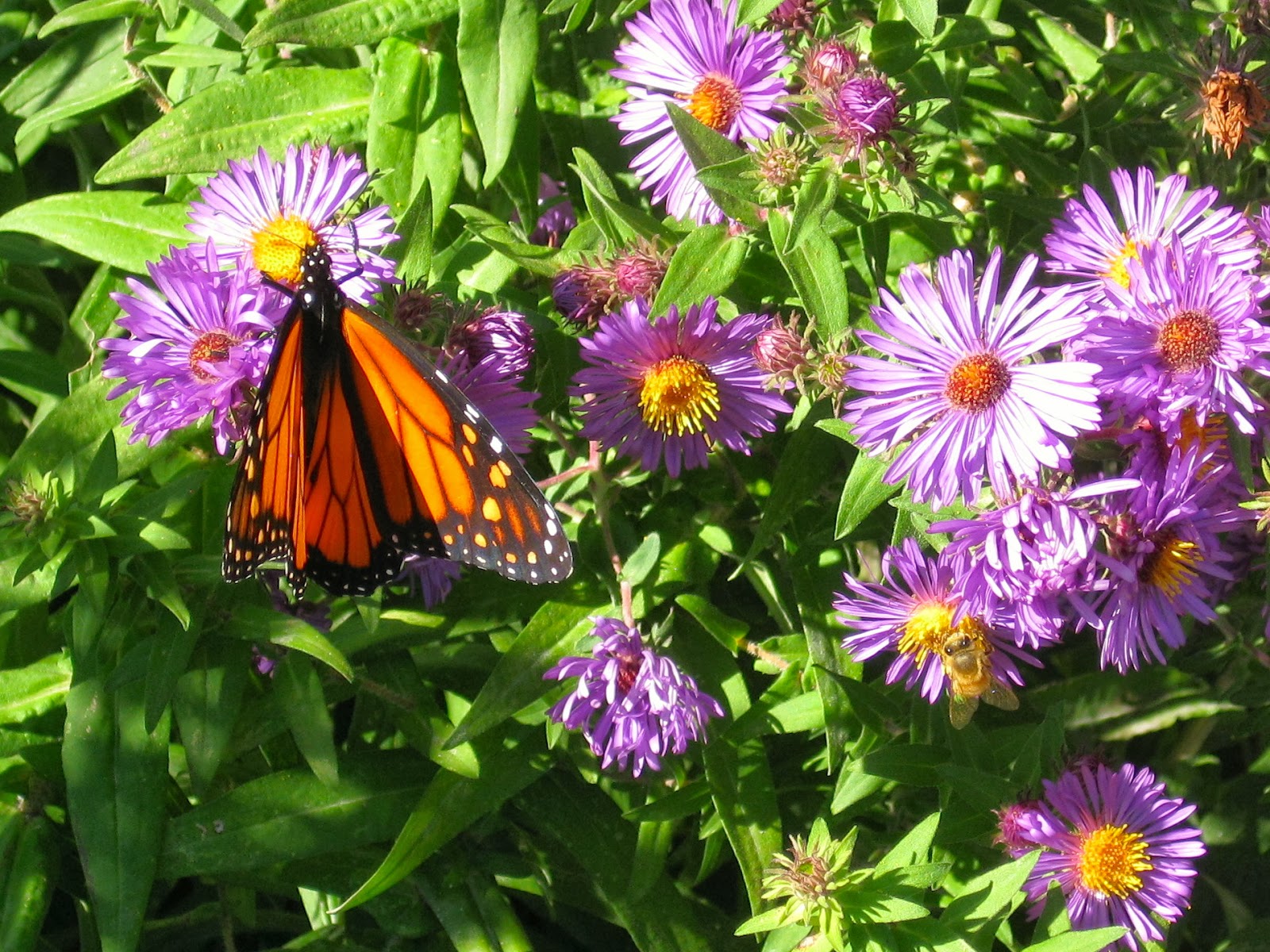
The monarchs return...finally...


On Sunday I was pleasantly surprised to spot a monarch fluttering in our native plant garden.  Upon closer inspection, I spotted 4, maybe 5, in total. 


Sulphurs were spotted fluttering nearby as well.


A great site for help identifying butterflies commonly found in Wisconsin is: